Art Web Blog

Posts Tagged ‘collage’

Madonna on Roller Skates, Squashed Behind a Phone Box

October 26th, 2009 by chris

tai-snaithThis week the spotlight is on Tai Snaith, a Melbourne-based artist who’s exhibited and performed all over the world from remote Scotland to ultra-modern Japan. She has worked with a variety of diverse media from pen to broccoli and performed in venues varying from gallery openings to being squashed behind a telephone box on the Royal Mile, Edinburgh. She is known in the arts community for organising collaborative and funded works and for her regular slot speaking on Tripple R radio program in Melbourne.

I caught up with her in Tokyo on her third visit to Japan; she’d just been to a flea market and picked up an antique Japanese doll for next to nothing.

What led you to become an artist?

I recall a conversation with my mum when I was small where she asked me what I’d like to be when I grew up. My reply was, “I guess I’ll just be an artist, what else can I be?”.  But after a little thought I asked her “can a girl be the Prime Minister?”. So I concluded “either that or an artist”.

You have an ongoing performance collaboration with Narinda Reeders called ‘Hit And Miss’.  Is there a recurrent theme in these performances?

By pure coincidence we both turned up to a party dressed the same – roller skates, red and white. We did know each other but we weren’t particularly close friends at the time, however we both concluded we should try the same thing next weekend. So next weekend we went to a friend’s gig dressed in suits. Because we were dressed up people expected us to perform, so we started hitting an egg on the dance floor with a stick.  And so it continued.

We found we didn’t like performing though – we can’t act and we just burst into giggles, so we decided to be still.  So for pretty much every installation our bodies were presented as dead objects. There’s a movement known as tableaux vivant (still life).  Before photography, wealthy people would pay people to reenact a painting, motionless, like “the last supper” etc. We started looking into it, but found that holding a pose for more than one hour is really hard. We realised we had been meditating in these positions, because we were breathing and relaxing and started to discuss what we were thinking about. This really brought us together and was really personal.

In terms of theme, we try to keep it playful – as we have nothing to lose but we like it to be a challenge at the sametime, hence the name ‘Hit And Miss’.  We think to admit failure isn’t such a bad thing, it’s an inherent part of creativity. We’re constantly embarrassing ourselves in front of people on purpose – it’s really therapeutic and very different to our own individual work.

What kind of reaction do you get?

hit-and-miss

I think the best reaction has to be the one we witnessed at the Royal Mile, Edinburgh. We were wedged between two phone boxes, our faces pressed against each other for an hour. One little girl came up with her dad and the following conversation ensued!

Girl: “What are they doing”

Dad: “They’re wedged behind the phone box”

Girl: “Why are they doing that?”

Dad: “Guess it’s probably art, darling”

Girl:“Yes but why are they doing that?”

Dad: “Well I think just because they can”

Girl: “Coool!”

During another performance where we had to be completely still, we had one kid was shouting at us “move! – stupid girls, come on MOVE!!!”.  It was really hard not to laugh.  One person kissed us; quite hard not to react and stay there.
(You can see more about ‘Hit And Miss’ on their website here: http://www.hitandmiss.me )

Are many of your performances/projects funded or commissioned?

Not usually. I might get an invitation but it will be along the lines of “can you come and do something at an opening – material costs covered”.

However I have been funded for working with groups of people and collaborations.  For example, “New Ruins” was a funded exhibition in old jail – it paid for six Glasgow artists to come to Melbourne and six artists from Melbourne itself.  The show was open for free to public;  it was only open at night and was pitch black so all the visitors were given a torch!

Another example of funded collaborative work was when I approached a private collectors group to sponsor an ‘art in houses’ project.

Tai Snaith 12

The group would pool their resources and periodically commission or purchase a single new work.  However, we wanted  funding to pair up several artists with home owners and get them to produce some work especially for those houses, which would then be open to the public for viewing. I came up with the suggestion that we use about 70% of the budget to fund the artists material costs and then the private collection would be able to choose one of the artists to commission a new work for which they would receive the remaining 30% of the budget [good business thinking Tai!]. The group loved the idea and it was a great success for all involved.  For my own work I was recipient of Australia’s Runway grant. This funded me to go to Berlin to do some work in “new media”, but all I did was give a talk about my work which doesn’t really have anything to do with new media!

What advice would you have for aspiring performance artists?

Don’t worry about what people think; do what you want to do without worrying about what the audience makes of it.  Inevitably some people will love it and some hate it.  It’s key that you get what you want out of it.  As long as you don’t rely on it to make you money it really doesn’t matter what people think.

Tai Snaith 11

Who’s your favourite performance artist

Daniel Freakly – The Quote Generator; he only speaks in quotes and is travelling the world at the moment

You also create some equally entertaining drawings and illustrations. First up, tell us about your Hirrafes!

Tai Snaith 02

I guess I started drawing them out of a subconscious  love of horses and giraffes. Giraffes have an ugly face and horses have a thick ugly neck, so one day I drew a ‘Hiraffe’.  A whole range of charactars have evolved.  In fact there was a period where all I drew were Hiraffes!

They don’t have bodies. There have been suggestions that I draw other similar animals, e.g. Gronky; half-donkey, half-giraffe, a Girony; half-giraffe, half-pony – but this sounded too much like a meat product.

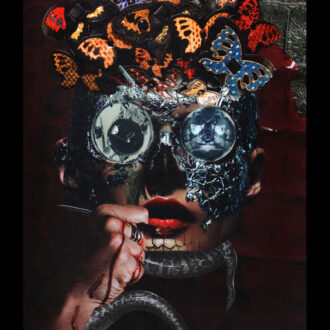
Amongst your collages, The Madonna/Chiwawa made me laugh my arse off.   In fact I think it’s the first image that comes to mind when I think of your work. With your collage is there any deliberate message, or are you just having fun as you make them?

Tai Snaith 10
Tai Snaith 06

The Chiwawa happened by accident.  I was cutting off the ears of  a chiwawa (not a real one!) and the head off a madonna for something else and they both were on the same table at the same time.  Then I realised what a perfect match they were!  I love collage; it’s one of my favourite things – it gives you so much freedom.  You work with these bits and they come together and make their own story; it’s like you’re a channeler.

Do you sell your work or have any of your drawing works been published?

Tai Snaith 01

I’ve had some of my illustrations published;

Maiden Voyage – book of illustrations, came out last month
Herding Kites – book of poetry and drawings (review)
Artichoke (my favourite review of a great performance by Post)
Curvy magazine – Annual book of female illustrations round the world

What’s next for Tai Snaith?

Thinking about having kids – and travel!

Generally I just strive to keep extending my boundaries and challenging myself rather than just staying happy.  It makes you feel alive.  I like feeling a bit nervous about things. I’d love to be able to achieve bigger things on a bigger scale, not just creating for the sake of creating, to use those skills to do something bigger.

Recently I’ve become aware of the importance of being creative and adding something critical; to work out what you are trying to express and communicate it in language;  “why have I drawn this picture?”.  To this end I spent ten hours the other day, without leaving my apartment, thinking about why I was obsessed with this particular plastic greyhound (that I was considering using for some work).  It really made me think about what’s on the inside of me,; like meditation,v it’s a way to give you time to think.

Tai Snaith 15

Thank you tai! you can get in touch with tai through her website www.taisnaith.com

Sarah Grinsted – From the Duffle Coat Pocket

February 6th, 2008 by chris

work-in-progress2.jpg

New for 2008 The Artists Web is starting a new column named ’spotlight’, where we will be featuring interviews with artists about themselves, their work and their inspiration. Sarah Grinsted is first in the hot seat and shares with us insights into her work, her background and her dufflecoat.

First up:

Part 1 – “Practical questions”


1) To start with, can you tell me a little bit about your artisticbackground?

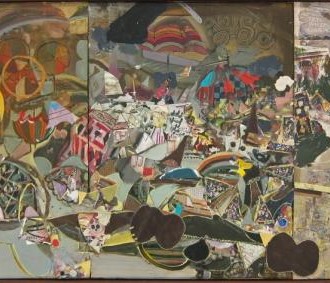
Enjoyed accumulating junk from an early age and turning it into sculptures or collages. Newspaper, eggshells, sweet wrappers, shredding, stamps or leaves, nothing was safe from being sneaked into the duffle coat pocket for a bit of cutting and pasting later. Studied Art and Art History at ‘A’ Level and various ceramics courses. Have been exhibiting paintings/collages professionally since 2006.


2) How do you make a living (now)?

I work as a Marketing Assistant at a theatre three days a week to pay the bills and aim to exhibit roughly every six months with any commissions and workshops filling the gaps in between.


Do you or have you ever needed to juggle jobs?

Definitely, until my own work generates a consistent income there will always have to be other part-time work. Luckily I have a very understanding employer, so if I need to I can be flexible with the days I work. And I live in my parent’s shed.


3) How do you motivate yourself?

Am generally inspired by everyday things around me, shapes, textures, colours. Unless I have specific plan or work in progress (i.e. some kind of actual deadline) I’ll go for a walk, take some photos, read a book, or sort through my endless boxes of paper and found materials until inspiration strikes. If all else fails, drink gin, watch films and wait till tomorrow.

I generally rebelled against most things I had experienced at school. I always resented copying the styles of other artists or having to provide numerous preliminary drawings and explanations before being allowed get my hands dirty.


4) How do you think success can be defined artistically?

By your own opinion, that your work keeps improving and continues to inspire you to create more.
By your work being appreciated by people whose opinions/work you respect
By reputation, repeated commissions
By exposure
By financial success.


5) Do you think artists need to be able to talk about their work in order to exist / succeed?

I could exist quite happily without having to explain my work, for it to be appreciated purely on a visual level. I find I get frustrated trying to translate what I’ve done into words and whatever I come up with starts to sound like pretentious arty twaddle. Whether you need to talk about your work in order to succeed would depend how you define success (see previous question).


If not, does it help to have a representative?

To have assistance from someone with experience of selling, pricing and marketing art is something I would definitely consider in the future.

I find I get frustrated trying to translate what I’ve done into words and whatever I come up with starts to sound like pretentious arty twaddle


How much of this business of artists having to talk about what they do is created by curators and galleries? Perhaps this is irrelevant?

I think its what people have got used to; they expect to see a CV, exhibition history and some explanation of the artist’s motives and influences alongside the artwork. It would be interesting to see whether if this information wasn’t available how this would affect people’s reactions to art.

Part 2 – Exciting and thrilling questions!

Yellow


6) From looking at the work displayed on
your website, I would say that to some extent you’re still “sneaking things into the duffle coat pocket for a bit of cutting and pasting later”.

Always. Not a day goes by when I’m not caught foraging in the recycling at the theatre, wandering through the churchyard stuffing my pockets full of fallen leaves or lingering with artistic intent next to a full builder’s skip…


7) How would you say your Art Education has influenced your work?

To start with I generally rebelled against most things I had experienced at school. I always resented copying the styles of other artists or having to provide numerous preliminary drawings and explanations before being allowed get my hands dirty. I wanted to get stuck in, feel the materials and experiment with them. That said, I have recently been taking drawing classes, reading books I should have read years ago and visiting art galleries more -
so probably more influenced than I would like to admit.

8)

Did you wear the duffle coat during Art classes?

The duffle, Mr Kirkland, is merely a comforting outer garment providing warmth and extensive storage facilities whilst ‘in the field’ collecting ’stuff’. Wearing one during the actual practice of collagification would not only be inappropriate, but somewhat sweaty.


9) How do you get started with a project?

An extremely sophisticated process of emptying out all available materials onto the floor, selected those that catch my eye and getting on with it. The joy of the kind of collage I’m doing at the moment is the more mistakes (or layers) that occur, the better the finished piece – there’s nothing a coat of cheap white emulsion and a good sand-down won’t fix!


Do you work on a painting-by-painting basis or over series of pieces?

Usually a number of pieces at once. I’m generally building up layers, so while I wait for one to dry I’ll start on another.


Does this affect your approach?

Yes. Subsequent pieces will either be an extension or improvement on the one before or an opposite reaction to it.


10) Do you ever feel like you’ve ‘finished’ something, do you know when to stop?

Yes, there is definitely a feeling of a piece being finished. What to do in order to get it to that point is the tricky part…


11) How do people react to your work? What’s the most notable reaction you’ve had?

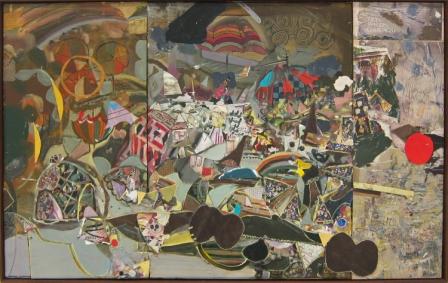
Generally the pictures I have exhibited so far seem to make people happy (I like to think that’s not just due to the free alcohol, fine music and ridiculous amounts of homemade flapjacks available at the private view). The abstract colours, layers, textures and shapes suggest things or places, but allow room for people to have their own reaction, without being intimidated or feeling they should understand some hidden meaning. Quotes from previous exhibitions:

‘Beautifully bright and feeley!’

‘Subtlety of marks and layers’

‘Made me very happy’

‘wonderful explosion of colour’

‘invitingly tactile and reflect almost hidden depths’


12) And finally, what are you working on now?

This week I have mostly been making things out of newspaper. More specifically bits of The Guardian travel section. Strips of photos – mountains and snow. But ask me again in a week and they may well be under a layer of something else!


Well many thanks for talking to us sarah, we’ll be keeping an eye on your website to see which parts of the Guardian make it into your next master piece!

Links