Art Web Blog

Archive for 2009

Shooting Stars…? Not Paul Blake (But Jesus Will Do….)

December 8th, 2009 by jadams

Paul Floyd Blake is a joy to talk to; polite, happy, relaxed and unfazed by the oh-so-noisy building works going on around me during the (unfortunate) timing of our interview.  He has every right to be happy at the moment too; having just won the coveted Taylor Wessing National Photographic Portrait Prize at the National Portrait Gallery for his picture of young swimmer Rosie Bancroft, doors of opportunity are suddenly opening for this former laundry-worker who decided to pursue his love of photography as a career only a few years ago.   Paul’s work documents people and everyday life in a way which is illuminating and which draws the viewer in, wanting to discover more.  His current project focuses on young Olympic hopefuls as they journey towards the ultimate dream of the 2012 Olympic Games.

Paul Floyd Blake


Congratulations on winning the Taylor Wessing Photographic Portrait Prize 2009!  How did it feel to get the award?  Did you think you were in with a good chance?

I knew it was a fantastic picture; I really liked the colours and I really liked the pose that Rosie had as well.    So I was quite confident that it would get into the book but in no way did I expect it to win!  Then I got a phone call while I was on holiday in Norfolk to say I’d got into the final four…so then I started thinking ‘I’ve won! I’ve won!’…until I saw the standard of the other entrants and then I started thinking ‘oh, well, fourth will be good!’.  It was just fantastic to be in that final four and then to go along on the night was really exciting.  I’d convinced myself by that point that I had come fourth and I was so surprised to be in that final four so to then actually win it was just fantastic.  The spin-offs from it have been brilliant.  I’ve already been approached by the Foreign Office to go off around the world taking photographs in other countries; that’s not been finalised yet but they’re still making enquiries to see how we can get that together.


How did the subject, Rosie Bancroft, react when she found out?

I invited Rosie and her family along on the night and she got herself a posh frock for the evening so that was lovely.  She was really excited by it all and as they were calling out fourth place – then third – and it still wasn’t us yet we started to get very over-excited!  So it was a really lovely experience.

Rosie Bancroft

You started studying photography as a mature student; has it always been a passion of yours and did you always envisage it as a career path?
When I was younger I wanted to go to art college but I was a pretty poor student really and more interested in playing football!  So I just didn’t get the qualifications I needed to go to art school.  I ended up in a series of  jobs in the laundry business which was actually quite good experience in the end; for the last five years I’ve been driving around, meeting lots of people and by then I’d already started taking photographs and thought it would be lovely to do little project focusing on all my lovely customers.  I didn’t really have the confidence or the time to do it then, what with trying to bring up two boys and do a full-time job.  Then my partner and I moved and it was my intention to start the same line of work in the laundy business in our location but she said to me , ‘look, rather than do something that you’re not that bothered about, why don’t you do something that you really like?’.  Then she shoved me off to college!  I ended up doing the first year of the National Diploma and that’s when things started working in my favour.  There was a photographer that I knew who invited me to assist him on a cultural programme on the Commonwealth Games.  That was a six-month programme and he very graciously let me take photographs rather than carry the bags.  Towards the end he was sending me off to do shoots on my own as he was so busy.  It was that time that really gave me confidence and made me believe that I could actually do this.  His name is Matt Squire by the way – I always feel I have to credit him because I’m that grateful!

You work for clients as well as heading your own projects and exhibitions.  Which do you find more challenging;
meeting the tight deadlines of others or ensuring your own work is successful?

I actually really enjoy doing both.  If my client work dries up for a bit and I’m just concentrating on my own work, I can get a bit lost in what I’m doing so it’s nice to have the contrast.  Likewise, if I’m only doing client work I get a bit worried that I’m not fulfilling my photographic yearnings if you like!  So for me, they really work well in tandem.

How easy (or difficult!) is it to get your work into galleries and published?  Is there any advice you could offer anybody trying to achieve the same?
In my experience, it’s having the front go just go and approach people and get talking to them!  I’m always sending my work off to galleries and I’m always trying to meet people from that field.  I’m not really a pushy person but when it comes to this I do think you just HAVE to meet and talk to people who work in that area.  Even if they’re not going to give you an exhibition, they are going to give you advice.

What inspires you to document certain themes or aspects of life?  Do you have ideas in your head or do you find yourself being inspired by a chance observation or random event?
I suppose I’m always thinking about ideas.  When I was younger I had a couple of friends who were very funny and who were great observationalists; one of them’s an actor now and spending time with them made me appreciate all the little details and idiosynchrases of people and since then I’m always on the lookout for those qualities.

If you’re looking around you, you’ll always see beautiful things going on and I try and pick those out.  Taking photographs sparks new ideas in itself anyway; you might take a photo of one subject and when it’s developed something else comes out of the picture at you and sparks off a new idea.

How is your current project On Track For 2012 going (apart from having just won a major prize, obviously!).  Are you finding that new ideas are coming to you as it’s going along or have you stuck to the brief you originally had a the start?

I had a shoot in London at the weekend and I got lost and then when I got to the venue it was one of these breeze-block-and-corrogated-iron structures with no natural light – generally a very sad venue!  I really struggled to get a nice picture with that set-up and after days like that it’s quite demoralising.  But generally it is going well and the ideas that come out of it are developing.  When I started it was just to capture a shadow of these people and to see them grow up and hope that one of them would get to the Olympics.  But as time goes on I’m starting to see a lot of other themes coming out of the work.  The ultra-professional world that these athletes live in, the amount of time and dedication – not only for the athletes but for the families as well – and the different relationships between the coaches and the athletes; all of these things are coming into the project.  I don’t know if I’ll be able to convey all these elements within the pictures but they all affect the way in which I take the pictures now.  The core of it is still seeing these youngsters grow up; it’s fantastic!  You start to feel part of their lives; I was there when Rosie Bancroft beat her personal best and I was there when Matt Roberts jumped his personal best and it’s so special to be there.  Even though I see them once, maybe twice, during the year, I do have dialogue with them throughout the year as well and try to get them to write about their experiences as they go along so for me it does feel like I’m getting to know them pretty well.  They’re letting me into their lives so it’s a big deal on their part too. And I hope that’s good for both of us!

How long does it take for a project or exhibition idea to take shape?  Can it develop over months or do you get an idea, decide on that and start to shoot it straight away?
They vary really.  For example, the ‘Show Us A Sign’ series (a collection of photographs of signs outside churches taken round the country) took a long time.  It was really enjoyable hunting down and finding these signs, some of which were very funny!  I’ve got over a hundred of those now and am hoping to get them published. From seeing and photographing the first sign, adding a couple more to the collection and then realising one day that this could be a great project – that was a couple of years.

'Show Us A Sign'

But sometimes it’s really nice to do a short project and sometimes that is the best way to do it.  If a project goes on for too long I find I can start going all formulaic with it.  The enthusiasm for it can wane as well.  So again I think it’s something that works best if there’s a mixture; one-day projects for some and others which take a whole lot longer!

You shoot with a large format 5X4 Wista Field Camera; have you always used this type of camera and what do you like about it?  Does it particularly suit the projects that you do for any particular reason?
First and foremost it’s got fantastic quality to it.  So for definition and information in the image it’s brilliant. Photographs taken with it have a very distinctive look to them which is another appeal.  It is actually quite difficult to use; they are the old-fashioned plate cameras – you put in one sheet of film and it takes time to set it up and to focus it and so on.  The other side is the cermony of it; when you’ve got a digital camera and you’re holding it up to your eye and firing away it’s reminiscent of the paparazzi!  People react differently to that style of shooting than they do to this camera because I have to go under a blanket and they see me using the bellows and so on and it seems to them to be more of an occasion.  They’re less afraid of it and more giving in their poses!

What has been your favourite exhibition or series that you’ve produced to date and why?
Well, you’ve got to enjoy doing them all really!  I suppose the one so far that I got the most enjoyment out of was the first one that I did which was called ‘Changing Faces Of Yorkshire’.  I was just starting a degree and started to explore the Pakistani community there.  That led me to explore other communities of Yorkshire so it was fantastic,  going to meet the South American community in Leeds, the West Indian community in Doncaster and so on.

It was a fantastic way of meeting lovely people and when I put the exhibition on in Halifax, loads of people came to see it.  And these were people who wouldn’t normally even consider going to galleries so to them it was a real occasion;  they all brought food and drinks and it was a really beautiful experience.  Whilst I want to make beautiful and intriguing images, I also want to make very accessible images that everyone can enjoy.

What place do you feel photography has in today’s society when it comes to documentation? Do you feel it’s sometimes trivialised by paparazzi and society’s obsession with celebrity?
Everyone takes images now, don’t they?  There are mobile phone cameras and digitals and so on…I must admit that I do think it’s a shame when people are at a gig or a concert and rather than take it in and watch it they’re standing there holding their cameras or phones up to take a picture.  You should just enjoy what’s in front of you in the moment!  I think there is a boom in photography; it seems to me that there are more photography competitions and contests going on and lots of organisations being established which promote photography and not just instant snaps.  That can only be a good thing; as far as the ‘celebrity shot’ is concerned, it does seem to be a bit of an obsession or a phase that society is going through at the moment!  For me, I’m not at all bothered about celebrity.  I’m interested in people and if they happen to be famous, all well and good but I wouldn’t photograph them purely because they’re famous.

Do you aim to provoke a certain response from your audience with your photography?
It’s difficult because when you take a photograph, you always want to produce something that’s special and which isn’t just a straightforward image.  I find it hard to create a sense of intrigue or vagueness in a picture.  So I’m sure  that I’ve still got loads to learn and a long way to go but I’m enjoying trying to make my way there!

Are there any downsides to the job?
It’d be horrible to say that there are because it’s just such a fantastic job!  So….no!

Would you recommend photography as a career to others?  How might you suggest somebody who is interested get started?
Try to assist someone; that’s always worth a shot because you get so much experience.  Sometimes people make photography out to be far more complicated than it really is.  I think that if you just put yourself in a position to take lots of photographs, you can actually really surprise yourself.  Just take photographs!  I learn from taking them and the more I take, the better I become.  I always make sure that I don’t go too long without taking some.

What do you love about your job?
It’s fantastic to be creative and it’s awe-inspiring when you take a picture and see the finished result and think  ‘wow…I took that!’.  Even more fantastic than that is the great excuse it gives you to go and meet lots of people! You can dip into their lives and make friends with them and so on.  For me, that’s the best aspect of it.

I’d like to thank Paul for his time and his allowing us a glimpse into his inspirational career.  You can see more of Paul’s work and his other projects at his website:

http://www.floydphotography.co.uk/

Jobs & artists opportunities available for December 2009 – January 2010

November 30th, 2009 by jadams
PAID POSITIONS

Title: Artist/Tutor, University of Hertfordshire/Luton Cultural Services Trus
Location: Hertfordshire
Salary: £30k-£40k pro-rata
Deadline: Friday 4th DecemberDEADLINE NOW PASSED
http://www.artsjobs.org.uk/arts-job/post/artisttutor/

-

Title: Mosaic Artist
Location: Bedford
Salary: £30k-£40k pro-rata
Deadline: Tuesday 8th December 2009DEADLINE NOW PASSED
http://www.artsjobs.org.uk/arts-job/post/mosaic-artist/

-

Title: Carnival Artist
Location: Bedford
Salary: £30k-£40k pro-rata
Deadline: Tuesday 8th December 2009DEADLINE NOW PASSED
http://www.artsjobs.org.uk/arts-job/post/carnival-artist/

-

Title: Celtic Arts Expert, World of Arts
Location: South East
Salary: £15k-20k pro rata
Deadline: Wednesday 9th December 2009DEADLINE NOW PASSED
http://www.artsjobs.org.uk/arts-job/post/celtic-arts-expert/

-

Title: Lead Artist – Alt Environmental Improvement Programme, Oldham Council
Location: North-West
Salary: £30k-£40k pro-rata
Deadline: Wednesday 9th December 2009DEADLINE NOW PASSED
http://www.artsjobs.org.uk/arts-job/post/lead-artist-alt-environmental-improvement-programme/

-

Title: Freelance Artist/Project Manager, Mansfield Museum
Location: East Midlands
Salary: £10k-15k pro rata
Deadline: Friday 11 December 2009DEADLINE NOW PASSED
http://www.artsjobs.org.uk/arts-job/post/freelance-artistproject-manager/

-

Title: Artist Commission, Stream
Location: London
Salary: £10k-15k pro rata
Deadline: Monday 14 December 2009 – DEADLINE NOW PASSED
http://www.artsjobs.org.uk/arts-job/post/artist-commission-4/

-

Title: Residency opportunity in Rome
Location: Rome!
Salary: £10-£15k
Deadline: Tuesday 15 December 2009DEADLINE NOW PASSED
http://www.artsjobs.org.uk/arts-job/post/residency-opportunity-in-rome/

-

Title: Art Co-ordinator, South London & Maudsley NHS Foundation Trust
Location: South London
Salary: £25-£30K pro-rata
Deadline: Friday 18 December 2009
http://www.artsjobs.org.uk/arts-job/post/art-co-ordinator/

Title: Creative Partner/Glass Artist
Location:South East
Salary: £10-£15k pro-rata
Deadline: Friday 18th December
http://www.artsjobs.org.uk/arts-job/post/creative-partner-glass-artist/

Title: Photographer, Logo Logo
Location: Surrey
Salary: £10k-£15k pro-rata
Deadline: N/A – see link for details
http://www.artsjobs.org.uk/arts-job/post/photographer-10/

-

VOLUNTARY POSITIONS

Title: Call for participation (Artists-Designers), The Market Estate Project
Location: London, Islington
Deadline: N/A – call for submissions is now open
http://www.artsjobs.org.uk/arts-job/post/call-for-participation-artists-designers/

-

Title: Artist opportunity, Beldam Gallery
Location: London, South East
Deadline: N/A – call for submissions is now open
http://www.artsjobs.org.uk/arts-job/post/artist-opportunity-1/

-

Title: Call to Artists – open submission, Folio
Location: London
Deadline: N/A – call for submissions is now open
http://www.artsjobs.org.uk/arts-job/post/call-to-artists-open-submission/

-

Title: Artist, Tip of the Iceberg
Location: South East, Hertfordshire
Deadline: Tuesday 01 December 2009DEADLINE NOW PASSED
http://www.artsjobs.org.uk/arts-job/post/artist-15/

-

Title: Exhibit next to van Gogh, for a minute!, The New Art Gallery Walsall
Location: West Midlands
Deadline: Wednesday 2 December 2009DEADLINE NOW PASSED
http://www.artsjobs.org.uk/arts-job/post/exhibit-next-to-van-gogh-for-a-minute/

-

Title: Installation/Visual Artists for devised theatre piece, The Effort
Location: London
Deadline: Friday 4 December 2009 – DEADLINE NOW PASSED

http://www.artsjobs.org.uk/arts-job/post/installationvisual-artists-for-devised-theatre-piece/

-

Title: Call for Artist Submissions, Surrey Artists Open Studios
Location: South East
Deadline: Friday 11 December 2009DEADLINE NOW PASSED
http://www.artsjobs.org.uk/arts-job/post/call-for-artist-submissions/

-

Title: Calling All Artists and Illustrators
Location: London, worldwide
Deadline: Thursday 24 December 2009
http://www.artsjobs.org.uk/arts-job/post/calling-all-artists-and-illustrators/

-

JANUARY 2010 DEADLINES

-

Title:   Photographer wanted for LITTLE TREASURES (Working Title)
Location:East Midlands
Salary:  £25-£30k pro-rata
Deadline:Monday 4th January 2010
http://www.artsjobs.org.uk/arts-job/post/photographer-wanted-for-little-treasures-working-title/

Title: Artists wanted to help deliver community engagement programme, Artes Mundi

Location: South West, Wales
Salary: £20k-£25k pro-rata
Deadline: Monday 4th January 2010
http://www.artsjobs.org.uk/arts-job/post/artists-wanted-to-help-deliver-community-engagement-programme-1/

Title: Artist Wanted for Pride Of Place
Location: South West, Dorset
Salary: £40k-£50k pro-rata
Deadline: Tuesday 5th January 2010
http://www.artsjobs.org.uk/arts-job/post/artist-wanted-for-pride-of-place/

Title: Dorset/Swindon/Torbay Commission 2010 (Light / sound), Torbay Council

Location: South West
Salary: £25k-£30k pro-rata
Deadline: Friday 8th January 2010
http://www.artsjobs.org.uk/arts-job/post/dorsetswindontorbay-commission-2010-light-sound/

Title: Artist Commission
Location: South East
Salary: £10k-£15k pro-rata
Deadline: Monday 11th January 2010
http://www.artsjobs.org.uk/arts-job/post/artist-commission-5/

Title: Sculptural Artist, Kidderminster Heritage Opportunities Group
Location: West Midlands
Salary: £15k-£20k pro-rata
Deadline: Friday 5th February 2010
http://www.artsjobs.org.uk/arts-job/post/sculptural-artist/

Hidden Sharks, Explosive Clouds & The London Underground – The Varied Career Of Mike Bishop!

November 27th, 2009 by jadams

This week’s ‘Spotlight’ is focused on illustrator and artist, Mike Bishop. Mike started his artistic career as a successful illustrator before journeying on to explore his personal art. Here, he offers his advice, shares his inspirations and gives us an insight into his chequered career!

Mike Bishop

How did your life as an artist begin and was it always something you wanted to do?
My Mum was quite artistic and she encouraged me to draw and paint with my two brothers at an early age..mainly eachother, literally.  At school I liked art because the teacher seemed a bit more friendly and normal than the other teachers so I took ‘O’ and ‘A’-levels in art. I did a foundation course at Farnham, Surrey for a year and then in 1977 went to Brighton Polytechnic (now university) to do a BA Hons in Graphic Design, specialising in illustration. I did have two years hiatus after the first year when I left to play in a band in London. However, our failure to become overnight jazz-fusion superstars – mainly because of the punk explosion – meant that this was short-lived and I was very happy when the college let me resume my studies, going on to get a 2.1 .

You have worked as an illustrator; how was your experience of working in this field and what advice could you offer to other artists considering this path?
Illustration is a good job but it tends to be stylistically changeable and cyclical, especially in the editorial and
advertising sectors. Art directors are always looking for fresh styles and there are always new students coming through. It also depends on the economy; I had a good run in the 1980’s and managed to get a good agent in London (Folio) which was a great help. Book illustration seems a bit more stable and though generally not as well paid as advertising work, may have greater longevity. My advice would be try to have an original style but be prepared to adapt and develop as the art director calls the shots.

You have worked for some impressive clients; how do you cope with artistic deadlines?  Do you find you thrive under pressure or is it sometimes stressful?

Mike's Tube Poster

I don’t mind deadlines; they’re often easier to handle than no deadlines at all. You always seem to get the work done even if it’s just by the skin of your teeth…even if the cat has just walked over the finished painting and you have to re-do it while the courier is waiting!

What has been your favourite illustrative piece that you’ve created and why?
My favourite commission was a poster for London underground. It was a very open brief, the subject being Soho at  night. I did two paintings and gave the art director the choice. Luckily he went for my favourite. It was great to travel round London for a time and see it printed larger than life.

Your other site focuses on your paintings.  When did you decide to explore this side of your work and why?
I lived in New York from 1990 to 1995 and it was there that I veered more towards painting. By this time I was getting a bit jaded as an illustrator and wanted to concentrate on my own work without the restraints of a brief. Being in a new environment is artistically stimulating and I loved the vibrancy of the city. I spent a lot of time just roaming around absorbing the sights.

You use oil and acrylic on canvas; why does this medium suit you and you used others?
I used to do a lot of colour pencil illustration but it went out of style. For my paintings, I like now to use a combination of acrylic and oil. I often use acrylic as the under coat as it dries fast and then finish off with oils as they tend to have better colours.

'Sunlight On The Garden'

Are your paintings based on places you have visited or are some from your imagination?
The scenes I paint are essentially real places but I like to refine and stylize them so they end up looking slightly surreal and unusual.

Any artists who inspire you to paint the way you do?
Some of the artists I admire are David Inshaw, Michael Andrews, Edward Hopper, John Singer Sargant;  most of the old masters and especially the Russian Itinerants.

Do you paint from memory, from sketchbook or do you paint on site?
For the bigger, more detailed paintings I use sketches and photos which I sometimes grid up to scale on the canvas. I also enjoy painting outside directly onto board or canvas using acrylics (again, as they dry quicker) with no  preliminary drawing at all. This makes a refreshing change from the more complicated pieces. Memory must come into it too, I suppose

'Suburban Myths'

.

You have some very interesting sky/cloud details in your paintings, especially the ‘Suburban Myths’ series!  The colours are very vivid; does the sky hold a particular appeal to you when you paint?
Yes, the vibrant sky in these paintings acts as a counterpoint to the often dark melancholic scene below.   Also there’s the hint that the clouds may not be all that they seem. In one painting I used a photo of an explosion as cloud reference and the aeroplane vapour trails add to this mystery; has a bomb just been dropped on an ostensibly peaceful English suburban scene? This adds to the slight sense of unease and, I hope, illuminates the fragile nature of a seemingly safe environment.

Do you aim to provoke a certain response or reaction from your audience with your painting or do you strive to keep ‘meaning’ ambiguous in your work?
I like ambiguity and the fact that people are free to find their own story in each picture. Everyone looks at things slightly differently and each response will be unque. One person thought that the reflection of a boat I had painted looked like a shark. It hadn’t occurred to me until they pointed it out!  Once a painting is finished it takes on it’s own personality.

How important is exhibiting to you and do you feel it’s essential for an artist to ‘get out there’ as well as having a website?
I like to exhibit although it’s not essential. Working towards a show can help structure your time and gives you something tangible to work towards.  You can also work on a series or theme and it can help to concentrate your thoughts. Also they can be self-educational; when I used to show at Francis Kyle Gallery, he would often have themed shows which would involve some research and travel to India or Russia, for example. Having a website is a good way of selling your work and getting it seen by a large number of people. You sometimes get intetesting emails from people all over the world.

'Last Summer Day'

How long does it take you to create a work from start to finish?
It depends on size, detail of finish, how complicated the subect matter is and again if there is a deadline.  Oh, and laziness!  A deadline will always speed things up. Generally the big detailed paintings take about a month.  If I’m working outsisde I like to finish in one session of about two hours.

What has been the high point of your career as an artist/illustrator?
Getting a first commision is always a thrill for an illustrator. Mine was when I was still at college for a book  about the Russian Revolution. I had to do a painting of Lenin talking to his troops from a train. I used my Dad as a model for Lenin. It ended up just looking like a my Dad with a false moustache on!  Later on, going to the newsagent to buy a magazine with your illustration in was a lot of fun. As far as painting goes, for me really the high point is always anticipating and starting the next one.

What is next in the pipeline for you?  Any new directions or exhibitions coming up?
At the moment I’m working on a series of horse paintings and continuing with the ‘Suburban Myth’ series.  I hope to show at the newly-refurbished Highgate Contemporary Art Gallery in London next year and possibly the Florence Biennale in 2011.

I’d like to thank Mike for his time and his contribution to ‘Spotlight’.  You can see more of his work at both his sites;

http://www.mikebishopillustration.com/

http://www.mbishopart.com/

French Fancies Fresh From The Palette Of Melissa Sturgeon!

November 16th, 2009 by jadams

In this week’s ‘Spotlight’, I’m talking acryllics, aspirations and all things Parisienne with talented and successful artist, Melissa Sturgeon.  Melissa’s work has already had me counting out my coppers to try and get the funds together to buy one of her evocative, alluring and whimsical French cafe scenes.  Her art literally tempts you to visit and frequent the subjects she paints….and one would and can happily get lost in them!

It is evident from your work that you are inspired by street scenes and buildings!  How long have you been painting these settings and what aspects of a building or street draw you in to the point where you want to paint it?
I started developing a love of painting buildings and street themes when I was studying illustration at Falmouth School of Art back in the mid 90’s.  As part of the course we were encouraged to develop our own work with one of our part-time tutors (who happens to be a very well-known Cornish painter called Rob Jones). I developed lots of sketchbook work based on the town, looking at details such as the architecture, bunting and tiny windows tucked into the eves of crooked rooftops.  It was the first time I remember really enjoying my craft and exploring what mad me tick. I was looking at everything differently and realised I had up until then been blind to everything around me. The aspect that draws me in is the feeling you get about the subject, of how it invites your senses and you want to find out more, beyond the walls and doorways.  You get a sense of mystery, of another time perhaps and wonder about how much life has taken place where you are standing. People often find they question what is happening beyond the doorways in the shadows, discovering the stories that might be unfolding.

Do you paint from memory, photograph, sketches you’ve done previously or at the scene itself?
When I travel, time is of a premium (unfortunately), so as well as a sketchbook I always have a camera with me. It is incredibly handy, especially when time is a big factor.

Mostly what I find I do is to sit somewhere, either at a café table, on the curb perhaps and just spend time watching the world around me, absorbing everything, using all the senses. You cannot bottle the atmosphere; it isn’t something that is tangible, you can only convey a feel for a place from your memories, from your own experiences, and try your best to translate that in your work.

There are a lot of Parisienne cafes and shops in your art; what is it about Paris that you love so much?
Where do I begin? Whenever I am in Montmartre I have this weird sense of belonging; perhaps I was a dancer at the Moulin Rouge in a previous life, who knows!!!  In all seriousness, every time I get out of the Metro at Abbesses and take the short walk up the hill to the Sacre Coeur, I feel like I’ve come home. I’m entranced by it’s beauty, it’s sense of history, how it still feels set apart from the rest of Paris as it used to be a hundred years ago.  It’s as popular to artists now as it was then, for all the same reasons: it’s rare that such a small area could be so inspirational to so many.
I was last there in December ’08, and spent hours under the canopy of a small piano bar drinking mulled wine and listening to Edith Piaf, as the rain was falling. It was late evening before I had to bring myself to leave.  The wild horses had to drag me away, else I would no doubt still be there!!

What feelings or reactions do you hope to arouse in people who view your paintings?  Do you aim for a certain reaction and if not, are you ever surprised by reactions that you get?
I would like to inspire in others the same feelings and arouse the same senses. I would like to invite the viewer to join me in those experiences. Many of my paintings have a very subtle idea of a narrative unfolding, using figures in my paintings to allow the viewer to connect with them and be a part of the storytelling.
What I love the most is hearing people talk about the honeymoons, the holidays, where they met and fell in love, even being born in the same streets as those I have painted and stirring up memories and moments in time for others – I find that sort of thing the most rewarding of all.

I love Paris and looking at some particular paintings made me want to either go back there or buy the painting!  Do people who buy your art tend to have visited the locations that you paint or do the paintings conjure up such lovely images that they have to buy them, regardless of whether they’ve been near there or not?
It’s true that many people who have bought my paintings have been to these places, re-iterating what we were talking about before; many have wanted to keep their happy memories alive. But that is not always the case; a lovely reporter for the Oxford Times who was reviewing an exhibition of mine singled out a particular painting. She described how she longed to sit at the yellow and white check table, to drink a cup of coffee with an absinthe chaser and to watch the world go by. I loved that so much, and it’s probably no surprise she later bought the painting.

Do you look for new locations to paint or do you only paint locations you’ve stumbled across which have touched you in some way?
I essentially paint places I stumble across, and don’t set myself any missions to find them; they seem to find me if I’m honest!!

You work with acrylic; why is this your preferred method and have you worked with other methods?  What made you choose acrylic?
Acrylics are a fabulous medium to use for so many reasons.  I used to use watercolours many moons ago – at school I guess – but was using them too thickly and consequently spent a lot of money on paint. Then I tried oils which I couldn’t get to grips with at all; smelly, took forever to dry – hated it! With Acrylics you have all the benefits of water-based paint with no nasty smells. You can use them thinly like a watercolour, or very thick like oils.  I use system three and I would never go back; the strength of colours is brilliant. My new best friend is the impasto gel from that range.  It helps to create layering effects, giving a great sense of depth. I couldn’t live without them now.

You used to work for a publishers but left because of the strict briefs which you felt stifled your creativity; what advice would you offer to artists starting out who may be taking work where they have to meet the requests of others rather than explore their own creativity with total freedom?  Is it a good thing to do for a period of time anyway?
I did briefly work as an illustrator, but I wasn’t fulfilled at all. I knew it wasn’t for me and it showed. However there is no harm in trying out many facets of the art world even if they merely help you to decide that’s not for you. For many, illustrating is the perfect combination; you love drawing and painting but you like the guidance and direction of others. But it wasn’t for me!

How is your career coping with the current economic climate?  Do you feel that artists are being badly affected by the credit crunch or have you not noticed much difference?

I actually haven’t noticed a big difference actually.  Art and the love of art is as vital to our world as needing a car or a refrigerator. I hope!!!!

Do you exhibit?  How important is getting your work out there as an artist?  Do you feel the need to get into the public domain or do you only use your website for that?

I do exhibit yes; you need to gain wider audiences and to build up your network.  Private views are a great way for people to meet the artist behind the work. It’s also great for meeting other like-minded people but I appreciate it can be a scary business too.

What is in the pipeline for you at the moment? Any new projects or paintings on the way?
I’m working on a series of smaller paintings at the minute all about the fun fair, incorporating lots of colour, light and movement.  It’s something a little bit different and I will see where they lead me!

What has been the high point of your career so far?
Hard question really, it’s all been good so far. It’s all a journey of self-discovery, much like life.

Any general advice you can offer to artists who may be starting out on their road?
Always be honest with yourself and others – your work will benefit from this.  Don’t try too hard; you don’t need to make a profound statement to impress people.  Remember what Hopper said, your work must reflect you, you are the work!!  Above all stick with it, and don’t ever lose heart.

I would like to thank Melissa for her time and her thoughts…..you can get a better insight into her work on her website:

http://www.melissajsturgeon-artworks.co.uk/

Fraser’s Work Is A Beautiful Game….

November 10th, 2009 by jadams

Fraser Kee Scott is certainly becoming recognised as a mover-and-shaker of the art world.  He opened his Notting Hill-based gallery (A Gallery) when he was just 19 and has since seemingly perfected the ability to see the message-beyond-the-skill that so often conceals an artistic talent that is set to become huge.  Hence, A Gallery has attracted a vast following of artists and critics alike, keen to see which new talent is being showcased by Fraser.  Revealer of the message-within-the-art and campaigner for making a change to the world by encouraging everyday folk to go out and buy art,  Fraser is certainly a busy bod.  But he kindly made time in his when-is-he-scheduled-to-breathe diary to speak to me about running a gallery, his passions and how to get a shedload of followers on Twitter.  But I’m not revealing that last discussion.   ‘Cos I’m going to use it first.

Fraser Kee Scott

Did you always intend to be a gallery owner or were you more inclined towards becoming an artist?
As a child If anybody asked me what are you going to be when you’re older, I’d say; ‘I want to be a painter’.  The
opportunity to run a gallery came up and it was a natural thing because my family are all self-employed and have shops or factories. Running a shop or a business was what they did so running a gallery just seemed the natural thing to do.

How do you spot an up-and-coming artist?
The thing that most people notice is the technical skill.  That’s the first thing that people will spot.  This actually goes against what the art establishment will tell you, but people who are not necessarily art critics or who don’t hold authority in art respond to technical skill.  However, that isn’t what I call great art; great art is the message within the work.  If the techincal skill’s there then the public will be more willing to consider it to be a good artwork and will therefore be willing to look for the message and take the message seriously.

Do artists approach you or do you seek them out?
We get sent resume emails every day from artists. Personally I’m not really looking for new art now because I’m more
focused on promoting the artists that we’ve got.

Fraser Scott's 'A Gallery', London

The last couple of artists that I took added me on their ‘Myspace’ sites, funnily enough! I had a look at their work and it was really amazing stuff.  So we put them on our website and then I sent out a press release.  The first day that the press release went out, we got them four pages in IT Magazine which was really great.  But I wasn’t looking; I just saw them!

How do you encourage the public who may not necessarily be ‘into’ art into your gallery?
We do all sorts of things.  We constantly send out information in any way that we can. The highest success has resulted from getting articles in GQ Magazine or The Evening Standard; stuff like that.  These get seen by hundreds of thousands of people so we promote to the press a lot.  We leaflet constantly, putting invitations around London and in people’s doors; we build up email lists of lawyers and architects and email them – all these methods are how we attract new people.

How has the recession affected you?  Do you feel that the art world has been quite badly hit or have you been ok?
We’ve sold more!  The last year we’ve definitely sold more than usual.  It’s got nothing to do with the recession but it’s got everything to do with what we actually do.

The bad thing about the media is that they are fear-mongers; they make their money from creating fear.  When the banks got into trouble, that was their problem and bad enough.  But the high street wouldn’t have suffered in the way that it did if the media hadn’t harked on and on about it.   As a result, people got scared and they stopped spending.  So we make sure that we don’t listen to it at all; we increase production and we’ve expanded.

'Soap And Dish'

On the subject of the mass media, they can give artists such as Damien Hirst and Anthony Gormley a bad press which may alienate the public from the artist.  How do you strive to draw artists and the public together?
I think that the government believes what the media says but it’s the public whose opinions can override what the papers would have us believe.  What comes out of some of these newspapers is disgusting and can cause a really negative effect.  So I don’t read the papers!  It’s not real or true – it’s a completely biased form of propaganda and it makes you question who are running them and what their intentions are.  Take for example the band, Coldplay; they make really good music, people like their stuff and respond well to it because of it’s beauty.  And then some of the papers print nasty and  backstabbing stuff about them and no matter what Coldplay produces, these papers will never be positive because being positive about this particular band is not that paper’s agenda. So when it comes to art, the thing to do is not to concentrate on the negative messages about art put out by those kinds of papers.  Focus on the media that will print positive stories.

Art has been getting outside a lot more these days; does this help the cause of bringing art and public together?
It does help.  The more exposure that you can get as an artist, the more you can get seen and heard by the public and the better off the public will be. If one person has a really bad day, then they come home and put on their favourite record, it can really ease the stress.  That’s just one person but if you take that to the level of society, art can do the same thing.  So the more public art that there can be, the more people relate to it as easing stress.  Following on from that, the more attendance we get to galleries and so on.  The more that the artist can have an effect on culture – and I’m talking about the creative artists who are putting out positive messages that are reflected in their art – the better society is.  And actually, society wouldn’t survive without these artists doing just that.

'Kate Moss' by Paul Normansell

Running ‘A Gallery’ obviously takes a huge amount of work and at times must become stressful; how do you balance productivity and stress so that you stay enthusiastic and positive about each work day?

I write poetry on the train and tube and it is certainly something that helps.  But essentially you have to remember that life is a game and – I don’t ever ‘work’!.  I play a game instead!  I’m not at work – I’m doing what I love and I’m helping and fulfilling my purpose.  Work is play with a purpose.

Any particular aspects of your job that you love?

It really cuts down to purpose and help.  Ultimately the need to help lies within us, be that helping ourselves or the groups that we belong to or society; if you talk to an individual about how they help society, you’ll generally find that the person who feels they are helping is happy.   Those who feel they are not helping or even doing the reverse, be that in the job they’re doing or the life they’re leading, can feel really miserable and not necessarily understand why they feel that way.  Art has a very high potential to cause an effect.  And that is why doing what I do is so fulfilling; I can hire an artist and help them and that in turn puts out a sphere of positivity to his audience.  When Paul Normansell, one of our artists, got a commission to do an album cover for The Killers, his mum was writing messages on his Myspace site saying ‘Oh, I’m so proud of him’ and so on!  For me that was one of the best things ever to see that knock-on effect of this artist having displayed in our gallery and the personal positive effect it was now having for him.

Any downsides?
Well, back to my ‘game’!  Any game is made up of barriers, purposes and freedom.  If you don’t have barriers, you don’t have a game.  Oh my God, there are LOADS of barriers in my job and major things to overcome.  But I can do it.   It’s not easy but even if these barriers are huge, once you’ve overcome them it’s all the better!

Do you have any exhibitions coming up that you’re really excited about?
Oh, yes!  We’re bringing Mercedes Helnwein over in a couple  of weeks to Notting Hill.  That’s going to be great; she’s really amazing and it’s going to be such a great show with so much work having gone into it.

'Knees And Crocodile' - Mercedes Helnwein

The standard is very, very high.  After that we’ve got a show called ‘Gloss’.  That consists of three artists;   Paul Normansell, Maxibillion Wiedemann who just did the VH1 ‘Divas’ campaign in New York and Mikael Alacoque, who is a recent graduate but he’s doing exceptionally well.  He actually worked for me in my gallery for six months and was one of the best graduates to come out of art school the year before last.  It’s called ‘Gloss’ because I was trying to find something that linked them all together and the word ‘gloss’ has a couple of definitions; one is to put a shiny surface on something to make it stand out and the other is to put a positive idea over something which is not necessarily viewed to be that positive, to ‘gloss over’ something.  It’s an interesting concept and the work is really strong in that show too.

Any advice you can offer to anybody who might be interested in persuing a career similar to yours – budding art gallery owners?
Just do it!

Any P.S.?
I’d just like to thank people who buy art!  It’s an important thing to do because they’re helping and supporting artists who are defining culture.  So I just want to thank the people who have supported us over the past few years and would like to encourage more people to buy because as I mentioned before with creating positivity in society, art has an extremely positive effect.

I’d like to thank Fraser for such an interesting and thought-provoking chat.  Nice chap.  Below are links to the aforementioned exhibitions:

Mercedes Helnwein – Whistling Past the Graveyard - 19th November to 6th December at Wanted Gallery, 15b Blenheim Crescent, Notting Hill, W11 2EE – http://www.agallery.co.uk/gallery.php?cat=8736

Gloss – Mikael Alacoque, Paul Normansell and Maxibillion Wiedemann – 10th – 30th December at Wanted Gallery, 15b Blenheim Crescent, Notting Hill, W11 2EE.  Mikael – http://bit.ly/2q5iFv,Paul – http://bit.ly/2v2yvQ,  Max – http://bit.ly/owUjs

Also check out Fraser’s ‘A Gallery’ website with plenty more artistic talent: http://www.agallery.co.uk/

Plus some great advice for artists on selling art!: (log in to Myspace first and then scroll down; it’s the seventh blog entry.  Be advised you may get seriously distracted by Fraser’s previous blog entries and end up reading those as well so allow some time for this!). http://tinyurl.com/yd3h2hv

Beach Huts And Fairy Dust!

November 9th, 2009 by jadams

In this edition of ‘Spotlight’, I’m talking to Wendy Massey, a successful member of The Artist’s Web whose career has included teaching in a young offender’s institute and producing children’s personalised art.   Wendy seems to have achieved the balance that many artists are striving to find; loving the work they do whilst earning enough from it to make a living!  I spoke to Wendy about her career shift, confidence issues and the enjoyment of craft fairs!

Wendy Massey

How long have you been creating both your art for children and your acrylic paintings?
The children’s side of it has probably been since the beginning of this year but the other art about 2-3 years.  I have another job on the side which is as a teacher but I only teach a max of about 8 hours a week. I don’t teach a lot of hours.  I teach crafts and literacy which is actually a good balance!

How do you manage to fine-tune the balance between your fitting in your day-job and your art?
It’s not easy!  It does focus you in a way because for example the teaching I know has got to be done and also the orders for children’s art that customers put in have got to be done so I’ve got that framework to work with and that motivates me quite a lot.  It’s also nice to do something different!  It’s easy to get bogged down doing the same old thing all the time so the change is nice – although fitting both in is a balancing act!

How did the children’s art develop from your original paintings?
What really pushed me into it was being made redundant!  That certainly made me jump!  I was teaching in a young
offender’s institute in a teaching managament role and that role was swept away with a re-structure. That was a huge leap for me primarily because it was a well-paid job.  I’ve gone from a good salary to being a starving artist!  I’d been thinking about the children’s art for quite some time and I just decided that with being offered redundancy, this was the time to do it.  So although it was a choice it was a little bit of a shove as well.  It’s something that I’ve always thought about because my life has always been quite child-orientated; I’ve got four children of my own and two grandchildren and they take up quite a big chunk of my time.  So I’m very aware of what things people do buy for children and the gift aspect of it.  I also think my style lends itself to children’s art anyway; it’s bright and colourful.

'Magical Fairy Canvas'


What sort of feedback to you get from people who buy your work?

I do a lot of art & craft fairs and also school fairs and I love watching people’s faces as they’re walking past and don’t know they’re being watched!  I like the reactions; usually people smile and I get a lot of good feedback there at the actual event.  People will say what they really like.  Getting feedback later is really nice as well; people will telephone or email once the event is over to tell me how much they like the art and how the child is enjoying it so that’s all good!  Feedback is really important for developing your work because people’s responses will trigger ideas that you haven’t yet thought of.

How important do you feel it is as an artist to ‘get out there’ and not just rely on your website?

It’s very important!  The main thing for me, as I’ve touched on, is the feedback; you need to know what’s working and what’s not.  The website is great but meeting people face-to-face, getting the responses first-hand and immediately is really helpful.  Another big bonus of ‘getting out there’ is having a break from working by yourself!  Again, it’s getting that balance right.  Sometimes I feel I’m doing too many fairs and not enough art production so getting the balance so that you’re happy with it takes some time.

You started your art career with many paintings of the seaside!  I can guess that you love it?
Oh, yes, I do love the seaside!  I find that I do paint what I’m inspired by – that’s natural.  I’ve not yet been able to live by the sea but maybe one day!

How do you get them done?
I do take photographs of anything I see that inspires me.  I’ll always simplify any photographs I take as I like my paintings to be quite simple. I do sketches as well; if I’m sitting on a beach, I’ll always have my sketch-book with me!  There’s a bit of imagination thrown in there as well. I don’t paint on site though!  I think that’s partly down to a lack of confidence to be honest.  I’m not always happy with all the stages of my paintings so I’d prefer not to do that in public.

There seems to be a lot of escapism in your art; is that intentional?

Oh, that’s absolutely important in my work! I’m not quite sure why I do it but I think it’s simply that we have to deal with so much heavy stuff day-to-day that it’s almost a release for me.  It’s an antidote to stress.  I absolutely love to put a smile on people’s faces!

Why do you choose acrylics?
I’ve tried more or less everything else!  I like acrylics because they’re so immediate; you can produce and finish your art quite quickly with them.  I’m quite impatient, especially when I’ve got an idea so I want to get it down, done and finished.  Even if the first draft isn’t perfect I like to get it done then I can always go back and improve on it later. If you’re not quite sure on the colour you can paint over it with no problem.  I don’t like the smell and the ’slowness’ of oils!  Although I’ve done a fair few watercolours but I feel that the colours themselves aren’t as bright.


Can you offer any advice to artists who may be wanting to start selling their art?

Yes!  I mentioned having a lack of confidence in getting out there and painting in front of people.  I think a lack in confidence can really hold you back.  There’s a book I read a while ago called ‘Feel The Fear And Do It Anyway’ (author Susan Jeffers) and the best piece of advice from that was to just get out there, drop your fear and do it.  Also, don’t let other people do all your selling, especially in the first few months.  I think it’s really important to do it yourself, not

'Peaceful Beach'

only in terms of it helping shape the direction you want to go in but in terms of your confidence levels.  Doing it yourself boosts your confidence no end!  Hearing people say that they like what you do – you’re the artist, you should be hearing it!  Another thing that’s really helped me with regards to selling my art is doing my online blog (http://www.1stuniquegifts.co.uk/blog/).   Promoting my work through the blog has been absolutely great and it’s really popular.


What’s next in the pipeline?

I’m definitely going to continue with the children’s art.  I’m interested in getting into designing and creating things for kitchens; some of the things I’ve been making have been bought by people for their kitchens, even though that’s not what I intended them for originally!  So producing something along the lines of wall clocks and so on would be great.  I’m thinking also about doing some prints of my work and personalising those prints by hand with names, dates and so on because I think that gives you a bit of a wider scope for selling. And it’s got to be commercial for me because this is my business!

I’d like to thank Wendy for kindly giving up her time and talking to me about her lovely art and life as an artist.  You can have a look for yourself at Wendy’s beautiful creations on her main art site and the site for her children’s art and gifts; http://www.1stuniquegifts.co.uk/

http://www.wendymassey.co.uk/

Art Jobs Page

October 30th, 2009 by jadams

Art Jobs page is down for updating with new positions and shall be restored tomorrow!

Admin

Richard Wilson makes my year as well as exceedingly-Good sculptures.

October 29th, 2009 by jadams

I feel very privileged to have recently had the opportunity to interview renowned sculptor and Turner-prize nominee, Richard Wilson.  In fact, having been a fan of his work for some time, it was tantamount to Christmas morning when you’re 6.  Richard was born in 1953 and his career spans over 30 years, during which time he has indulged in installation, sculpture, sound and performance and has exhibited across the globe.  Twice nominated for the Turner Prize, his work has been described as ‘daring’, ‘innovative’ and has achieved critical acclaim the world over. His more well-known pieces have involved rotating parts of a derelict building with jaw-dropping effect, filling vast rooms with sump oil to create an illusion that is truly mesmerising and creating a corner of a building that makes no architectural sense whatsoever.   Richard’s work gets people talking, reacting and changing their perspectives on what were ordinairy structures, which, with a little of Richard’s magic treatment, transform into the extraordinairy.

Is it easy to get the permission of galleries to do an installation considering some of your works involve  part of the building itself?

It is actually! I’m very sensitive to any requests for new works.  For instance, with ‘Turning The Place Over’, they wanted a big flag-waving piece for Liverpool’s Year as European Capital of Culture 2008.  So I couldn’t create something the size of a thimble necessarily.  I’ve spent most of my career playing around with architecture so most people think my sculptures are big, but if you’re working with architecture you have to work to an architectural scale. ‘Turning The Place Over’ was created in a tower block; to others that seems really big but in the architectural world it’s completely normal.  So it’s only because of the nature of what I’m tampering with that there appears to be a huge scale implied.  You can’t outprice yourself when you’re dealing with installation. You can’t go and expect an  individual collector to agree to something that’s way out of their control scale or size-wise.

Initially seeing the work start to move made me feel almost uneasy!  Was this effect intended?

It only makes one feel uneasy because one is so unfamiliar with seeing architecture move.  All architecture vibrates because the planet vibrates but one doesn’t see that and it’s not visible to the human eye.  So once you start putting glass and concrete on the move, there is an element of structural daring; this piece is on the first floor and you have to look up to it.

It was all worked out with the help of engineers so even though we weren’t doing anything silly or threatening, I think it just makes people look at it and think ‘my god, how does that work?’; architecture isn’t supposed to move around or leap out of buildings.  ‘Turning The Place Over’ is about many different things; the title is about turning rules on their heads; not just architectural rules but the fact that we generally think we know what we’re looking at and when you tweak it like this you get a new set of issues being raised.  One of the things I love about it is the fact that people have come from all over the world to look at a derelict building!  It’s enabled people to start talking about something which had been completely written off by the local authority.  So you don’t have to knock it down and build something new; you tweak what’s already there in some way. With art you can make people look again, look afresh at the situation and change their perspective of it.

Your latest piece, ‘Square The Block’ was unveiled last month; the bottom section is quite chaotic in appearance.  Did you intend any irony by placing such a ‘chaotic’ look on the London School Of Economics which seeks to find answers and logic to social structures?
No irony, not really.  It’s a very quiet piece; if you look at the bottom section and then follow it up,  it’s almost as though you wouldn’t realise that the corner’s been ‘pegged on’. You’d struggle to know that in passing by.    I put the piece that some people view as ‘chaotic’ at the bottom to try and do two things.  One is to draw attention to the building so people think ‘my god what’s going on here?’ and they look up and then start to recognise that it’s a fake corner.  The two vertical parts that make up the corner are absolute nonsense and make absolutely no architectural sense; you’ve got half-windows and the frames go round the corner!

'Square The Block'

Basically I’ve chosen two random strips of building but when you put them together they (very deliberately) don’t make any sense.  Another purpose of the ‘chaotic’ lower part was to free up the walkway because if I’d taken that corner down to pavement level it would not have been allowed because it’s a public right of way.  So I was looking at various ways of finishing the building above head-height.  Architecture works to order and once demolished looks like a pile of rubble but I thought ‘well, by crushing the bottom bit up, it’s looking at the two aspects of architecture; created to form and as a pile of rubble!’.  I have to be very careful in all these situations; when I’m tampering with somebody else’s building I have to be careful that I’m not insensitive.  London School of Economics is seen as a place of learning; I felt putting that piece on the corner highlights where they’re at this moment in time; they are existing in the contemporary world and using that art as a badge saying ‘we are progressive’.

Many of your sculptures are created outside.  Are you hoping to encourage more art to be displayed outside after years in galleries?
Art’s always been outside!  It’s only the last couple of centuries that it’s gone indoors!  Centuries ago, passers-by were able to understand about religion from looking at the artwork that was put on churches and cathedrals.  I’m just reverting back to what was normal!  I can’t bear the idea of ‘public art’ – it implies statues in parks; sculpture can be indoors or outdoors, especially if you’re playing with architecture; sometimes the architecture is outside if you’re playing with a particular façade and other times it’s indoors so I’m really not campaigning to get sculpture outside.
When it comes to precautions outside, one has got to be quite careful how influenced one is by the Health & Safety officer!  It’s one of the real issues I have to deal with when working outdoors but fortunately so far I’ve had people come around to my side of things. Other problems; with a piece like ‘Square The Block’, you have to go to your local authority to get permission from the planners to go ahead and that can be a stumbling block.

You mentioned the Health & Safety Officer!  How restrictive can dealing with safety laws be on your work?

Rules and regulations are very restrictive and they are beginning to affect the aesthetic.  I just feel I have to be very careful and really look at the situation and fight back if I feel they’re being unreasonable.  I could get on my high horse about this but it’s beginning to affect so much that it feels like we’re being wrapped up in cotton wool.  The big pieces I do with a structural engineer and having that kind of support really does help carry you through it.

How big are the teams that you work with?

It depends.  I don’t actually employ people and have a personal team.  I used to.  The last job where I brought a group of people in who became my team was for the Folkestone Triennial piece when we put the huts together, the beach huts (‘18 Holes’).

'18 Holes'

That was the only time and that was because I found it difficult work with part of the concrete and it was easier to get a team together to take care of that.  If  I’m working on projects like ‘Square The Block’  or ‘Turning The Place Over’, they can have very, very big teams but they don’t necessarily work for me.  I come up with the idea and I’ll then go and find structural engineers to look at the project and say ‘yes that’s do-able, we’ll put it through our computers and test it for you’.  They may okay it but then suggest getting a mechanical engineer in to also see if it’s do-able.  Then we may use a construction company who actually build it.  Then you might need a surveyor to say how much it’s going to cost and to budget the whole thing for you.  So all these people are professionals in their fields of construction.  However, I don’t personally employ them; they’re paid by whoever’s holding the budget at the time.  In my practise now I work a lot with drawing, model-making and talking to people about how to do things and then we work together as a team but they’re not strictly at my studio.  So it’s unfortunately and quite rarely that I’m actually in my studio.  I’m lucky in that whenever I approach somebody to become part of that team, they’re always chirpy and enthusiastic.  It’s rare that I’ll find somebody throwing up a lot of negatives; if they do, I try and go and find somebody else to work with!  It can be stressful!  For me to set myself up in the legal aspects of my business (coming back to health and safety), can be incredibly costly; business protection, insurance; these things combined can be astronomical!  Everyone is afraid of being sued for doing something wrong and that’s understandable.  But I just don’t earn that sort of budget with the bigger pieces to be able to run a business like that.  It’s far easier to go out to businesses who already have that kind of protection in place.  This is by no means new territory; people like Anthony Gormley are working in exactly the same way.  The bigger pieces of work have to go through professionals.

You’re taking one of your well-publicised pieces, 20:50, (a vast lake of sump oil which reflects perfectly it’s surroundings) to Kurdistan for the Post-War Festival 2009.

We open on 6th November and it’ll be there for about three months.  I was asked to do some work for the arts festival there, the first one of it’s kind.

'20:50'

I thought it would be relevant to do 20:50 for two reasons; firstly, it’s the oil in Kurdistan, it’s relevant, most of the situations with oil out there are warring situations where they’re fighting for permission and rights to well the oil and it’s an interesting piece to do there.  Secondly, working out there is a complete unknown.  Rather than going out and suggesting a piece I want to do, new, and discovering that it’s absolutely impossible to do and that they don’t have the expertise, knowledge or materials, I thought it would be better to go out there and do something that I know how to do.  Generally, I very, very rarely repeat myself.  20:50 is the only piece that I’ve ever repeated before so I thought it would be better to do that again.  It’ll be in Sulaimanya which is the cultural centre of Northern Iraq.

I’ve heard rumours about a work in St. James’s, Chelsea…can you spill a few beans on that?

That’s a piece of work that is currently in storage and ready to be assembled when the building site stops being a building site!  That’s a much smaller piece over at St James’s Development which is over the dock very close to Chelsea Bridge and is a residential development with a large square piazza.  I was chosen via Futurecity to do a piece of work in that space.  It’s a casting.  I’ve been looking at the kind of architectural conundrum of allotment structures.   It’s based on the idea of a hut on an allotment site; when you look at such a hut, it’s obviously been put together from a lot of rubbish.  If you then transfer it and from a model-maker’s perspective make a model of it, you start to file out all the ‘rot’; all the bits that don’t quite fit or are a bit odd and you start to fashion and then design that form.  So we’ve ended up with three structures, one balanced on top of the other.  Like a Chinese whisper, they’ve been interpreted by a model maker and they’ve been transformed from a lot of broken bits to a cast panel.  It’s all about transformation.

Do you have all the ideas for your work running around in your head or are you inspired by what you see and your surroundings?

It’s interesting; I find that ideas are very, very difficult!  I do have ideas for sites that were never given the go-ahead for reasons such as it proved to be too expensive, or the site wasn’t big enough -  so those ideas were put on the back burner.  People will ring up for me to do a piece of work and I’ll go along and see if any of those ideas can be fit into the site on offer, whether it be a gallery site or an outdoor site.

'Set North For Japan'

Then I’ll start to play with that idea, just testing it to find the best way in which it might fit.  Once I’ve found a way for it to fit I can put the proposal forward.  I did a piece in Japan a few years ago (‘Set North For Japan ( 74 °33’ 2″)’ – 2000)

- and on the flight back the idea for it came as soon as I took off.  I couldn’t wait to get home and start drawing about it so I became very excited about it.  On the plane I became interested in the relationship between the distance from where I was coming from and where I was going back to.  I realised there was a way of talking about that relationship and distance by copying my house and transferring it around the world but not building it  using the verticles and horizontals of Japan but using the verticals and horizontals of London.  Literally like pushing it up through the ground from London so it pops up on the other side of the world but in the angles of the place it’s just come from!  It talks about distance; there are these two houses on the planet which are identical but because of their positions, one is the right way up and the other has been pushed through the earth and has arrived upside-down!  That was a fascincating piece of work to do.  The concept of that was really strong.  If you spend too much time on a project – say a month or two – I think it’s really dangerous because you end up having worked through yourself and your idea and you can find yourself quite lost.  You’ve got to dump everything you’ve been doing and come at it afresh.

Your job sounds very enviable!  Any downsides?

I’ve done some seminal works around the world and have become well-known for them.  But a problem can come about when the audience then expects you to go one better, like ‘Turning The Place Over’ and ‘Square The Block’ – they happened very close together.  Whichever big piece follows those, people are going to start to say things either like ‘so what are you going to do next, are you going to go one better?’ or they might start saying ‘oh this new one’s not as daring as those two pieces’.  You do get compared to your braver work but you can’t always be brave like that!  It might be that your next client wants a very quiet piece or a piece that doesn’t have that grand structural scale; it could be a very small work that fits quietly in one corner somewhere.

'Butterfly'

So doing those big, daring pieces can often backfire on you because you end up being compared all the time to them.  It becomes a bit difficult to live up to.  I have to be very careful of not getting caught into the trap of thinking ‘ how can I be more daring than the last piece’ with every new piece of work and that can often throw you off course and that’s when you start to struggle with an idea.  I’ve been doing this for over 30 years and not just sculpture; its been quite a chequred career with installation, sculpture and also sound and performance.

I think you have to be varied; I can look at some other people’s works and see that they’re stuck.  I think that happens when you become too afraid to explore other areas. I find that in this country art can be quite ‘set’; for example the train of thought that you can’t use film in sculpture.  But I have used it as I feel it presents time and process in sculpture which sculpture by itself can’t always do.  So pieces like ‘Butterfly’ (2003), crushing the aeroplane and then stretching it back out and using something to record it that process, I find go beautifully hand-in-hand.  But that’s a difficult concept for many people to accept.  ‘One Piece At A Time’(1987) also used sound; that piece had to exist for only five weeks.  As I was dealing with a strict period of time it was originally a structural piece that became an acoustical piece that was also another idea of transformation.

Do you have any favourite pieces that you’ve done?

Hmmm..I like ‘She Came In Through The Bathroom Window’ (1989).

That was a very simple work where the piece enlisted some of the architecture in which it sits. I took the window and pulled it into the room.  ‘Water Table’ (1994) is also a favourite of mine.  ‘Turning The Place Over’  is also.  And I suppose I have say ‘Square The Block’!  It has very interesting qualities which I always feel mean that the ideas are moving on although it’s a much quieter work.

'She Came In Through The Bathroom Window'

I think it’s dangerous to say there’s one piece of work that I really love because if I pick one I did at the beginning, it sounds as though I’ve been going downhill for the last 30 years!  And why does one do these things?  I do them for myself.  I know that if they don’t excite me then I’m not going to excite my audience.  I take not just architecture but other things such as an aeroplane, a ship; objects that are structured and built within our world and I tamper with them in some kind of way.  What I’m trying to achieve by doing that is to make us see those things in a new way and that metaphor is saying ‘don’t pre-judge things’.

I’d very much like to thank Richard for his generous time and for being so nice, friendly and chatty!  You can see Richard’s fascinating and much-discussed work on his website below, listed with some details of his other current and future projects.  Be sure to check them out and try to see some of this sculptor’s amazing work if you can.

http://www.richardwilsonsculptor.com/

‘20:50′ opens on November 6th 2009 for the Post War Festival 2009 in Sulaymaniyah, Kurdistan http://www.artrole.org/pwe_programme.php

Exhibiting 20th November 2009 at ‘Works/Projects’ in Bristol – http://www.worksprojects.co.uk/

Next year Richard  shall be starting work on a commission for Marylebone Magistrates Court in London.

Madonna on Roller Skates, Squashed Behind a Phone Box

October 26th, 2009 by chris

tai-snaithThis week the spotlight is on Tai Snaith, a Melbourne-based artist who’s exhibited and performed all over the world from remote Scotland to ultra-modern Japan. She has worked with a variety of diverse media from pen to broccoli and performed in venues varying from gallery openings to being squashed behind a telephone box on the Royal Mile, Edinburgh. She is known in the arts community for organising collaborative and funded works and for her regular slot speaking on Tripple R radio program in Melbourne.

I caught up with her in Tokyo on her third visit to Japan; she’d just been to a flea market and picked up an antique Japanese doll for next to nothing.

What led you to become an artist?

I recall a conversation with my mum when I was small where she asked me what I’d like to be when I grew up. My reply was, “I guess I’ll just be an artist, what else can I be?”.  But after a little thought I asked her “can a girl be the Prime Minister?”. So I concluded “either that or an artist”.

You have an ongoing performance collaboration with Narinda Reeders called ‘Hit And Miss’.  Is there a recurrent theme in these performances?

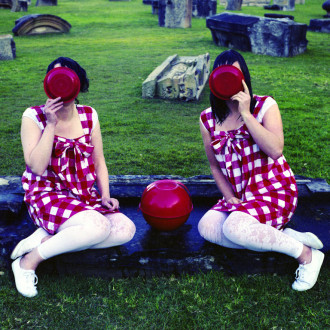
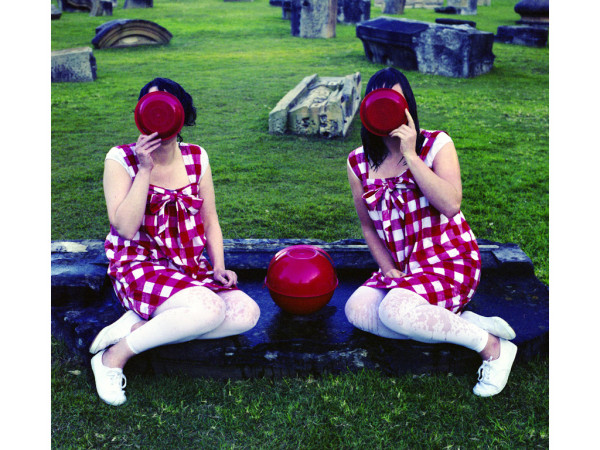
By pure coincidence we both turned up to a party dressed the same – roller skates, red and white. We did know each other but we weren’t particularly close friends at the time, however we both concluded we should try the same thing next weekend. So next weekend we went to a friend’s gig dressed in suits. Because we were dressed up people expected us to perform, so we started hitting an egg on the dance floor with a stick.  And so it continued.

We found we didn’t like performing though – we can’t act and we just burst into giggles, so we decided to be still.  So for pretty much every installation our bodies were presented as dead objects. There’s a movement known as tableaux vivant (still life).  Before photography, wealthy people would pay people to reenact a painting, motionless, like “the last supper” etc. We started looking into it, but found that holding a pose for more than one hour is really hard. We realised we had been meditating in these positions, because we were breathing and relaxing and started to discuss what we were thinking about. This really brought us together and was really personal.

In terms of theme, we try to keep it playful – as we have nothing to lose but we like it to be a challenge at the sametime, hence the name ‘Hit And Miss’.  We think to admit failure isn’t such a bad thing, it’s an inherent part of creativity. We’re constantly embarrassing ourselves in front of people on purpose – it’s really therapeutic and very different to our own individual work.

What kind of reaction do you get?

hit-and-miss

I think the best reaction has to be the one we witnessed at the Royal Mile, Edinburgh. We were wedged between two phone boxes, our faces pressed against each other for an hour. One little girl came up with her dad and the following conversation ensued!

Girl: “What are they doing”

Dad: “They’re wedged behind the phone box”

Girl: “Why are they doing that?”

Dad: “Guess it’s probably art, darling”

Girl:“Yes but why are they doing that?”

Dad: “Well I think just because they can”

Girl: “Coool!”

During another performance where we had to be completely still, we had one kid was shouting at us “move! – stupid girls, come on MOVE!!!”.  It was really hard not to laugh.  One person kissed us; quite hard not to react and stay there.
(You can see more about ‘Hit And Miss’ on their website here: http://www.hitandmiss.me )

Are many of your performances/projects funded or commissioned?

Not usually. I might get an invitation but it will be along the lines of “can you come and do something at an opening – material costs covered”.

However I have been funded for working with groups of people and collaborations.  For example, “New Ruins” was a funded exhibition in old jail – it paid for six Glasgow artists to come to Melbourne and six artists from Melbourne itself.  The show was open for free to public;  it was only open at night and was pitch black so all the visitors were given a torch!

Another example of funded collaborative work was when I approached a private collectors group to sponsor an ‘art in houses’ project.

Tai Snaith 12

The group would pool their resources and periodically commission or purchase a single new work.  However, we wanted  funding to pair up several artists with home owners and get them to produce some work especially for those houses, which would then be open to the public for viewing. I came up with the suggestion that we use about 70% of the budget to fund the artists material costs and then the private collection would be able to choose one of the artists to commission a new work for which they would receive the remaining 30% of the budget [good business thinking Tai!]. The group loved the idea and it was a great success for all involved.  For my own work I was recipient of Australia’s Runway grant. This funded me to go to Berlin to do some work in “new media”, but all I did was give a talk about my work which doesn’t really have anything to do with new media!

What advice would you have for aspiring performance artists?

Don’t worry about what people think; do what you want to do without worrying about what the audience makes of it.  Inevitably some people will love it and some hate it.  It’s key that you get what you want out of it.  As long as you don’t rely on it to make you money it really doesn’t matter what people think.

Tai Snaith 11

Who’s your favourite performance artist

Daniel Freakly – The Quote Generator; he only speaks in quotes and is travelling the world at the moment

You also create some equally entertaining drawings and illustrations. First up, tell us about your Hirrafes!

Tai Snaith 02

I guess I started drawing them out of a subconscious  love of horses and giraffes. Giraffes have an ugly face and horses have a thick ugly neck, so one day I drew a ‘Hiraffe’.  A whole range of charactars have evolved.  In fact there was a period where all I drew were Hiraffes!

They don’t have bodies. There have been suggestions that I draw other similar animals, e.g. Gronky; half-donkey, half-giraffe, a Girony; half-giraffe, half-pony – but this sounded too much like a meat product.

Amongst your collages, The Madonna/Chiwawa made me laugh my arse off.   In fact I think it’s the first image that comes to mind when I think of your work. With your collage is there any deliberate message, or are you just having fun as you make them?

Tai Snaith 10
Tai Snaith 06

The Chiwawa happened by accident.  I was cutting off the ears of  a chiwawa (not a real one!) and the head off a madonna for something else and they both were on the same table at the same time.  Then I realised what a perfect match they were!  I love collage; it’s one of my favourite things – it gives you so much freedom.  You work with these bits and they come together and make their own story; it’s like you’re a channeler.

Do you sell your work or have any of your drawing works been published?

Tai Snaith 01

I’ve had some of my illustrations published;

Maiden Voyage – book of illustrations, came out last month
Herding Kites – book of poetry and drawings (review)
Artichoke (my favourite review of a great performance by Post)
Curvy magazine – Annual book of female illustrations round the world

What’s next for Tai Snaith?

Thinking about having kids – and travel!

Generally I just strive to keep extending my boundaries and challenging myself rather than just staying happy.  It makes you feel alive.  I like feeling a bit nervous about things. I’d love to be able to achieve bigger things on a bigger scale, not just creating for the sake of creating, to use those skills to do something bigger.

Recently I’ve become aware of the importance of being creative and adding something critical; to work out what you are trying to express and communicate it in language;  “why have I drawn this picture?”.  To this end I spent ten hours the other day, without leaving my apartment, thinking about why I was obsessed with this particular plastic greyhound (that I was considering using for some work).  It really made me think about what’s on the inside of me,; like meditation,v it’s a way to give you time to think.

Tai Snaith 15

Thank you tai! you can get in touch with tai through her website www.taisnaith.com

Heroic work, Mr Firrell!

October 21st, 2009 by jadams

‘IT SEEMS IMMENSELY TIMELY TO ME TO EXPLORE WHAT WE REALLY MEAN BY HEROISM’ – Martin Firrell
‘COMPLETE HERO’ BY MARTIN FIRRELL AT THE GUARDS CHAPEL LONDON
Public art digital projections of text and video to the chapel exterior
The Guards Chapel, Birdcage Walk, Wellington Barracks
4-10 November 2009
17.00 – 21.00 nightly
Opening 4th November at 17.00

Martin Firrell is well-known for placing provocative statements on London’s major cultural institutions in the form of light-projections, illuminating his thought-provoking texts.  Following ‘The Question Mark Inside‘, the public artwork that lit up the dome, West front and Whispering Gallery of St. Paul’s Cathedral in November 2008, Martin Firrell returns with Complete Hero at the Guards Chapel.

‘Complete Hero’ is a characteristically stirring projection of text and moving images that explores contemporary ideas of the meaning and value of heroism.  What is a hero? Who do we choose to admire and why? What does the future of heroism look like?  The Guards Chapel, the spiritual home to the Household Division of the British Army, provides a particularly timely and poignant backdrop for this discussion.

THERE ARE MANY WAYS TO BE STRONG

Firrell has conducted interviews with men and women of the Household Division and wider Army, with direct
experience of active service,  including Lance Corporal Johnson Beharry VC and with actor Nathan Fillion speaking of male heroes in popular culture, with writers Howard Jacobson and Adam Nicolson speaking of the hero in literature, with philosopher A C Grayling, evolutionary geneticist Dr Adam Rutherford and with the iconic writer and speaker April Ashley.

Firrell has also invited members of the public to contribute their own views and ideas via the project blog at www.completehero.com to help inform the final form of the projected work.
‘Complete Hero‘ marks the very first collaboration between a public artist and the Guards Chapel, an historic first in the site’s 171 year long history.

For further information please visit www.completehero.com